


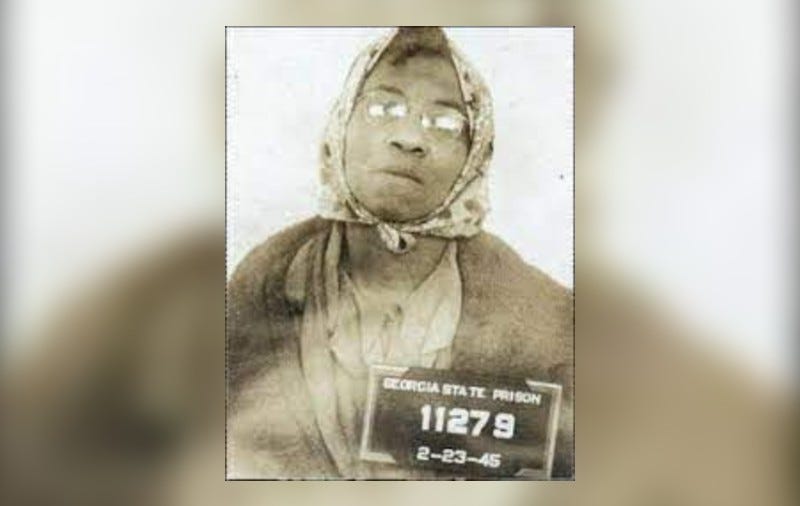
Georgia sent a 44-year-old mother of three to the electric chair in 1945 after a one-day murder trial before an all-white, all-male jury. Lena Baker maintained that she killed Ernest B. Knight while trying to escape a man who had confined her and threatened her life. Six decades later, the state granted her a posthumous pardon. The Georgia Board of Pardons and Paroles later acknowledged that refusing her clemency had been a “grievous error” in a case that called for mercy.
Baker remains the first and only woman executed in Georgia’s electric chair, according to the New Georgia Encyclopedia. Her case unfolded in Jim Crow Georgia, where a Black woman’s claim of self-defense against a white man was judged within a segregated criminal justice system that excluded Black citizens from meaningful participation.

Our Black Girls is an independent, reader-supported publication. If you believe in amplifying the stories of missing Black women and girls, please consider making a direct gift through PayPal or Buy Me a Coffee, or by subscribing here.
Baker Said Knight Held Her Against Her Will
Born in 1900 near Cuthbert, Georgia, Baker grew up doing farm work with her family before supporting herself and her three children by cleaning homes and washing clothes. Ernest B. Knight, a 67-year-old white gristmill owner, later hired her to care for him while he recovered from an injury. The New Georgia Encyclopedia reports that Knight eventually began locking Baker inside his mill for extended periods.
Historical accounts describe their relationship differently. The Guardian reported in 2005 that Baker and Knight had a sexual relationship, while Baker’s testimony focused on being held against her will and threatened. Knight’s son also admitted in court that he had previously beaten Baker after finding her with his father.

Baker also testified that Knight forced her from her home on April 29, 1944. She eventually escaped and spent the night outside, but Knight encountered her again the following day and took her to his gristmill, where she said he locked her inside while he left. The Black Commentator, drawing from research into the trial record, detailed the sequence that preceded Knight’s death.
When Knight returned, Baker said she wanted to leave. According to her testimony, he refused and raised an iron bar used to secure the mill door. A struggle followed involving Knight’s pistol. The gun discharged, killing him.
Baker immediately went to county coroner J.A. Cox and reported that she had killed Knight. She maintained that she had acted because she feared for her life. The New Georgia Encyclopedia preserves that account from the court record.
A Four-Hour Trial And A Death Sentence
Baker went on trial in Randolph County on Aug. 14, 1944. The proceedings lasted only several hours, and the jury consisted entirely of white men. After rejecting her self-defense claim, jurors convicted her of murder and did not recommend mercy, making death by electrocution mandatory under Georgia law at the time. The Los Angeles Times later reported on the circumstances when Georgia issued her pardon.
Gov. Ellis Arnall granted Baker a 60-day reprieve so the Board of Pardons and Paroles could review her case, but the board denied clemency in January 1945. She was transferred to Georgia State Prison in Reidsville the following month.
On March 5, 1945, Georgia executed Baker by electrocution.
Her recorded final statement returned to the defense she had maintained from the beginning. “What I done, I did in self-defense, or I would have been killed myself.” She also said she held nothing against anyone and was ready to meet God. The New Georgia Encyclopedia reports that she was pronounced dead at 11:26 a.m.
Baker was buried near Mt. Vernon Missionary Baptist Church in Randolph County, where she had sung in the choir. Her grave initially went without a formal marker. Church members placed a simple marker there decades later.
Georgia Pardoned Lena 60 Years After Her Execution
Renewed attention to Baker’s case eventually led her relatives and advocates to seek a pardon. Her great-nephew Roosevelt Curry formally pursued the effort with support from the Prison and Jail Project.
On Aug. 30, 2005, the Georgia Board of Pardons and Paroles granted Baker a posthumous pardon 60 years after her execution. The board said the decision to deny clemency in 1945 was a grievous error and that her case called for mercy.
The pardon did not declare Baker innocent. The board specifically said it was not making that finding. Instead, it concluded that the circumstances could have supported a voluntary manslaughter charge rather than murder, which would not have resulted in her execution.
In January 2011, family members and supporters gathered at Mt. Vernon Baptist Church Cemetery to dedicate a new headstone honoring Baker. Curry told the Albany Herald that the effort to obtain justice for his great-aunt had begun with only a handful of supporters before growing over the years.
More than 80 years after Georgia executed Lena Baker, her case continues to appear in examinations of race and capital punishment. In 2026, the Death Penalty Information Center included her case in its review of Georgia’s history of racial violence and the death penalty, pointing to the four-hour trial, all-white jury, and later pardon.
Please share Lena Baker’s story so the circumstances surrounding her trial, execution, and posthumous pardon remain part of the historical record. She is our sister, and her life mattered.

Join the Our Black Girls conversations on Facebook, Instagram, X, and TikTok. Stay updated on the latest cases, developments, messages from survivors, and much more.